The largest independent, international conference dedicated exclusively to engineering simulation.
Attendees discovered new technologies & innovative techniques, whilst networking with end-users, software vendors, consultants and academics, in this worldwide celebration of simulation.
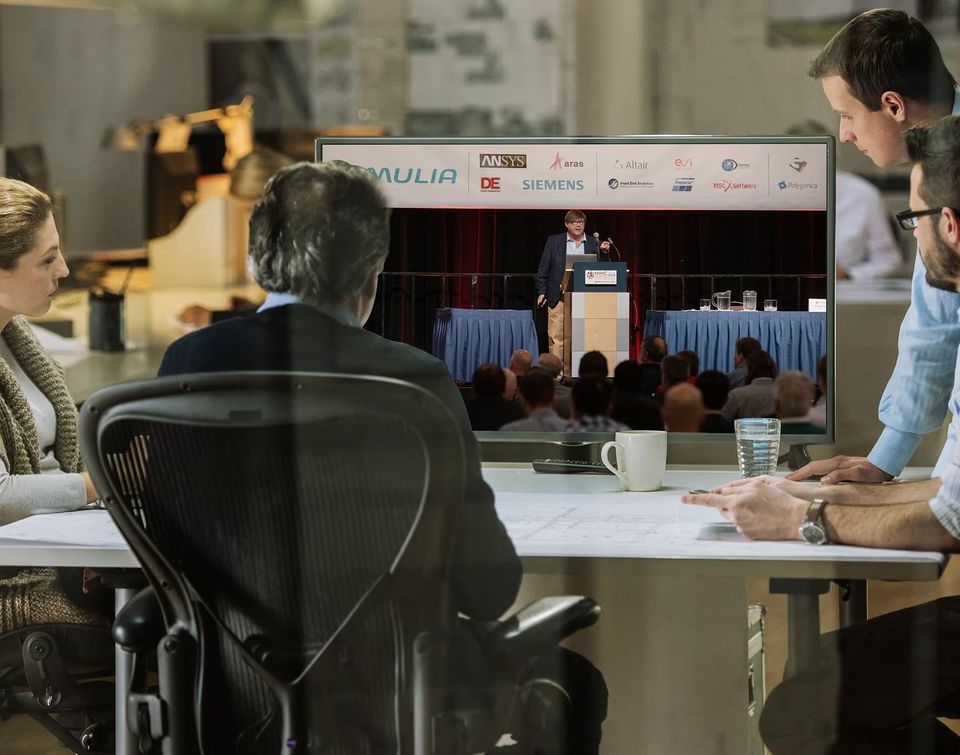
Traditional methods of training are changing. NAFEMS is stepping up to the challenge by providing you with a range of training options, all available remotely, all available from home, and all keeping to the same, internationally renowned, independent standards.
NAFEMS provides the engineering analysis community with as many as fifty seminars, conferences, workshops and open forums throughout the world each year. As the only truly independent organisation dedicated to engineering analysis and simulation NAFEMS' events are widely held to encompass the broadest and most accurate view of the community available.
This is your community. Now more than ever, we're working harder to deliver more opportunities for you to stay connected during these challenging times.
The NAFEMS Resource Centre provides a gateway to all of the technical material produced by NAFEMS. It enables access to our publications, magazine articles, webinars, papers and presentations.
Relevant material can be found by searching by keyword, filtering by multilevel technical categories or filtering by author, organisation, or type of resource.
There are currently over 8,000 resources in the centre with this number growing weekly.
As an organisation dedicated to promoting the best use of simulation and analysis and with our wealth of experience within the analysis and simulation industry, there is no better place to further your professional development with our quality and worthwhile training to reach your goals.
Keep track of your development using the PSE Competency Tracker, and get PSE Certified to demonstrate your skills to current and future employers.
Be recognised as a valued independent authority that operates with neutrality and integrity
We focus on the practical application of numerical engineering simulation techniques such the Finite Element Method for Structural Analysis, Computational Fluid Dynamics, and Multibody Simulation. In addition to end users from all industry sectors, our stakeholders include technology providers, researchers and academics.New Column
Head of Research Department of Digital Twins for Healthcare & Senior Lecturer in Computational Cardiovascular Modelling at Kings College London
After completing her PhD in Aeronautics at Imperial College London, Dr de Vecchi worked at the University of Oxford on methods for precision modelling in cardiovascular applications. This experience defined her research interest in modelling to investigate the mechanistic aspects of cardiac physiology. She is now leading a research department at King’s College London focused on combining Digital Twin technology and in-vivo data. Her vision is to enhance synergies between mechanistic and data-driven models to enable the full potential of the digital twin paradigm to infer physics-based mechanisms in the cardiovascular system and beyond.
Digital Twins for Healthcare: The Long-winded Path to Clinical Translation
As AI technology and data availability in healthcare advance at a fast pace, the field has seen a large number of digital twin models aimed at predicting treatment outcomes, enabling early diagnosis and supporting patient management. However, the clinical translation of these models has been slow. This talk explores the challenges preventing clinical adoption, framing them through practical examples developed by our Research Department of Digital Twins for Healthcare, before proposing future directions of research and development for the Digital Twin community.
Javad Fatemi
Systems Architect - Launcher Structures & AIRBUS Expert Composite Structures at Airbus Defence and Space
Dr. Javad Fatemi is an Airbus Expert in Composite Structures and Systems Architect for Launcher Structures at Airbus Defence and Space in the Netherlands. Built on more than two decades of extensive academic and industrial experience, he integrates academic insight with practical reality to significantly advance credible simulation practices in aerospace industry.
As a technical lead at Airbus, Dr. Fatemi has played a leading role in developing advanced technologies for thermal protection systems for hypersonic vehicles and composite structures for launchers. His work focuses on demonstrating how physics-based computational modelling and simulation—founded on rigorous principles of Verification, Validation, and Uncertainty Quantification (VVUQ)—can transform and accelerate the development and qualification of aerospace systems.
Demonstrating his leadership in the field, Dr. Fatemi serves as a member of the ASME VVUQ90 subcommittee, which is developing a new standard titled “Airframe Structures Modelling & Simulation Credibility Assurance Framework.” Through his contributions, he continues to promote trustworthy computational models for the design and qualification of aerospace structures.
Establishing Simulation Credibility for Aerospace Structures via the VVUQ Framework
Aiming to reduce time-to-market and cost, the development and qualification of aerospace structures increasingly rely on numerical simulations. To ensure these simulations are trustworthy for critical decisions and product qualification, the credibility of computational models and simulations must be demonstrated. The Verification, Validation, and Uncertainty Quantification (VVUQ) framework provides a systematic approach to assess and ensure simulation credibility. This framework focuses on verifying simulations, managing uncertainties in both simulations and tests, and validating simulations against experimental data—ultimately enhancing confidence in the accuracy of numerical simulations.
The implementation of the framework is demonstrated through a case study of a composite launch vehicle structure within a European Space Agency technology program. This case study highlights how the VVUQ framework is used to develop credible simulations for accurately predicting the stiffness and failure load of the composite engine frame in the launch vehicle. The framework enabled a successful blind prediction of the full-scale engine frame test results, thereby validating its effectiveness in developing credible simulations. This proven methodology has the strong potential to significantly reduce or eliminate the need for costly full-scale testing in the qualification of composite aerospace structures.
Steven Pierson
Propulsion CAE Senior Technical Specialist at Jaguar Land Rover
Steven is the Senior Technical Specialist within the Propulsion Department responsible for defining the Propulsion CAE strategy across all disciplines, delivering integrated processes and methodologies to support the delivery of BEV and xHEV powerpacks. He has gained significant experience in powertrain thermal fluid systems and analysis.
Steven started his career working in BAe Military aircraft developing computational methods for predicting aerothermal signatures, before joining Jaguar Cars to work on internal combustion engines. Soon after joining Jaguar he undertook his PhD at Cranfield University developing virtual techniques for modelling port fuel injection and gaining experience in advanced Lazer measurement techniques.
The Virtual Verification Factory: A Step Towards the Engineering Continuum
A different approach to Computer Aided Engineering is required to support the development of future vehicles. The exponential increase in complexity, the accelerated rate of technology change all coupled with the need to dramatically reduce the time to market requires a different approach to Computer Aided Engineering. Continuing to grow the CAE teams organically is no longer an option from cost and operational perspectives. Propulsion CAE has developed, and is implementing, the concept of the "Virtual Verification Factory". Where a factory is defined as "A person or organisation that continually produces a great quantity of something specified". The following presentation will define "Industrial" Computer Aided Engineering and how adopting a "Virtual Factory" approach will enable faster engineering decisions to be made. The purpose of the virtual factory is to detect potential causes of failure, report and mitigate risk and is built upon the principles of Failure Mode Avoidance. The Factory is then organised into specialist halls, allowing chapters to develop mastery in their particular specialism and optimise efficiency. At the heart of the factory is the concept of working in the continuum, providing near live risk status and design recommendations for the hardware and software that define our products. Clarity and visibility are provided through common language and dashboarding and where virtual tests and virtual test assets are twinned with the physical.
Professor Chris Waldon FREng
Deputy Director at STEP Chief Engineer
Chris became Chief Engineer in August 2023, following his role as STEP Fusion’s Delivery Director. A Fellow of the Royal Academy of Engineering, he brings over 30 years of delivery experience across the nuclear, pharmaceutical, chemical, refining, and power generation sectors. Since joining UKAEA in 2003, he founded the Central Engineering Department and served as UKAEA Chief Engineer. In his current role, Chris is accountable for the overall whole plant design, its performance, all key decisions supporting the prototype powerplant, and the ownership of technical risk.
From Uncertainty to Capability: Shaping an Ecosystem that Learns Faster than the Technology Evolves
The Spherical Tokamak for Energy Production (STEP) programme aims to deliver a UK prototype fusion energy plant by 2040, paving the way to commercial fusion viability. Fusion plant design presents unprecedented engineering challenges, requiring extrapolation into unknown regimes and adaptive approaches to accommodate evolving scientific and technological discoveries. The published STEP prototype powerplant (SPP) concept highlighted the complexity of system integration and the need to balance design objectives-generating 100 MWe net electrical power, tritium self-sufficiency, high-grade heat, and commercial-level availability. Design evolution has explored larger machine sizes, alternative architectures, and solid breeder blankets. Technology development roadmaps and digital modelling are central to increasing design confidence, enabling predictive capabilities and rigorous extrapolation from experimental conditions. STEP’s Digital Vision underpins this approach - applying innovative, practical, and human-centric digital technologies to navigate a volatile, uncertain, complex, and ambiguous (VUCA) environment, drive best-for-programme integration, and transform complex programme delivery.
This site uses cookies that enable us to make improvements, provide relevant content, and for analytics purposes. For more details, see our Cookie Policy.
By clicking Accept, you consent to our use of cookies.