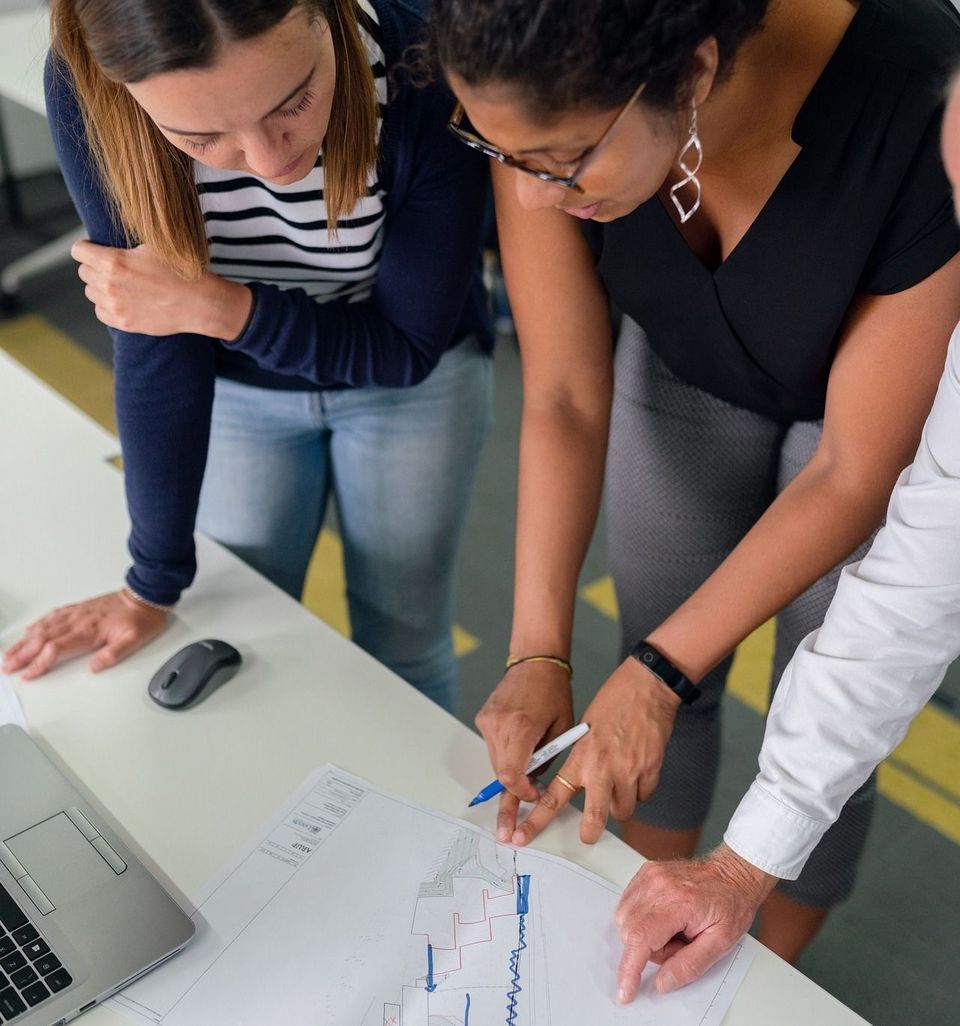
The largest independent, international conference dedicated exclusively to engineering simulation.
Attendees discovered new technologies & innovative techniques, whilst networking with end-users, software vendors, consultants and academics, in this worldwide celebration of simulation.
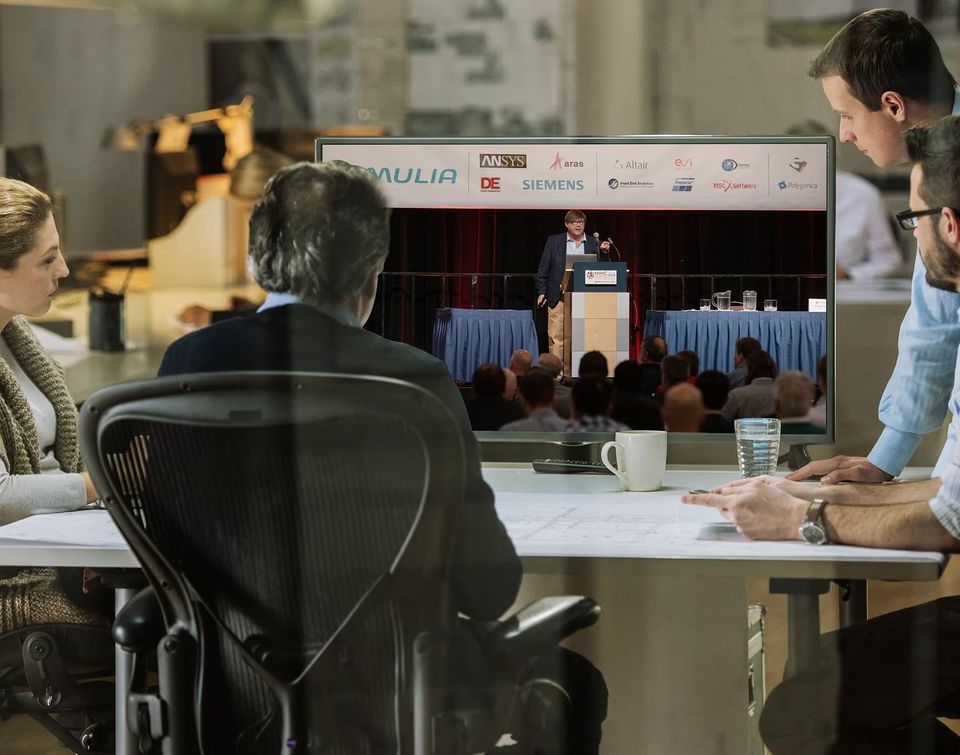
Traditional methods of training are changing. NAFEMS is stepping up to the challenge by providing you with a range of training options, all available remotely, all available from home, and all keeping to the same, internationally renowned, independent standards.
NAFEMS provides the engineering analysis community with as many as fifty seminars, conferences, workshops and open forums throughout the world each year. As the only truly independent organisation dedicated to engineering analysis and simulation NAFEMS' events are widely held to encompass the broadest and most accurate view of the community available.
This is your community. Now more than ever, we're working harder to deliver more opportunities for you to stay connected during these challenging times.
The NAFEMS Resource Centre provides a gateway to all of the technical material produced by NAFEMS. It enables access to our publications, magazine articles, webinars, papers and presentations.
Relevant material can be found by searching by keyword, filtering by multilevel technical categories or filtering by author, organisation, or type of resource.
There are currently over 8,000 resources in the centre with this number growing weekly.
As an organisation dedicated to promoting the best use of simulation and analysis and with our wealth of experience within the analysis and simulation industry, there is no better place to further your professional development with our quality and worthwhile training to reach your goals.
Keep track of your development using the PSE Competency Tracker, and get PSE Certified to demonstrate your skills to current and future employers.
Be recognised as a valued independent authority that operates with neutrality and integrity
We focus on the practical application of numerical engineering simulation techniques such the Finite Element Method for Structural Analysis, Computational Fluid Dynamics, and Multibody Simulation. In addition to end users from all industry sectors, our stakeholders include technology providers, researchers and academics.New Column
Verification & Validation in Engineering Simulation
***No spaces remaining - please contact lisa.rimback@nafems.org to be placed on the waiting list***
Online Training Course
Verification and Validation in Engineering Simulation
16 - 20 October | Online (Webex)
Engineering simulation plays an increasing role in industry’s search for competitiveness and technology based innovation at any stage of the design, qualification and certification of their products. Key decisions and product qualification/certification increasingly rely on virtual tests and computational simulations, creating a major paradigm shift in which the objective of physical tests is progressively moving from a demonstration of compliance to a reference for simulation validation. This trend in industry is shown through adoption of new terms such as “realistic simulation” and “virtual testing”. This situation creates new responsibility for the engineer to guarantee the required confidence level.
This new approach requires secured processes for the verification and validation (V&V) of simulations bringing evidence of their predictive capability. In particular, programme managers now require formal evidence on “simulation fit for purpose” on which they can build confidence and take decisions. In addition, the increasing situation for extended enterprise creates new constraints to guarantee safe and robust analysis processes.
At the same time, and due to the economic pressure, V&V activities are frequently seen as an additional cost that can easily be reduced and even fully cut, thus underestimating the induced risks. In addition, V&V is not easy to implement because of the diversity of involved persons: managers, simulation experts, test specialists, software developers and quality controllers, software vendors…
Course objectives and benefits
This Master Class is especially dedicated to V&V and credibility assurance methodologies for numerical simulation in Engineering. Participants will:
Develop their knowledge in V&V including fundamental concepts, most recent methodologies and contents of existing standards.
Understand essential links between the product validation/certification and simulation V&V.
Learn how to plan and prioritize simulation V&V including physical tests programmes.
Understand validation test issues and improve synergy between virtual and physical tests in the context of validation.
Learn how to build business cases allowing for justification of V&V plans.
Understand simulation V&V organisation and management issues and best practises
Learn how to implement reporting to bring visibility and confidence to all managers concerned with simulation outcomes.
Be able to adapt or tailor the course methodologies to their specific industrial context, and further improve their V&V processes and plans.
Who should attend?
Primarily experienced engineers and senior analysts in charge of simulation activities or preparing to take new responsibility in the management of simulation, especially regarding V&V responsibility
Managers in charge of engineering simulation teams and willing to improve their simulation V&V knowledge
Programme/project managers and stakeholders from regulatory bodies who need to make critical decisions based on engineering simulation results and wish to increase their understanding of simulation V&V.
Participants should have a solid experience in engineering simulation for the design and development of industrial products.
Course context
Are concerned with this course all industry sectors confronted with numerical simulation V&V, and primarily those sectors where simulation is playing a critical role for the product design or certification. The course is established on the solid knowledge of the tutors and the vision they have developed from their rich industrial experience, mainly within the aerospace and nuclear energy sectors and is primarily illustrated by FEA/Structure Analysis examples. The course is therefore of greatest interest to engineers involved in this technical domain but will also appeal to engineers from other simulation domains because most of the V&V methodologies which are presented are generic in nature.
The course is neutral and independent of any particular software solution.
We limit the number of participants to a small group to facilitate dialog and exchanges between participants.
Master Class Program
Introduction
Introduction, scope of the course
Simulation fundamentals, simulation process
Simulation credibility assurance for decision making, simulation criticality
Verification & Validation of industrial products
Basic concepts : ISO V&V concepts, qualification & certification of industrial products
Systems Engineering : main concepts, focus on system V&V
Hierarchical validation
Impact of product innovation
Simulation management with focus oncredibility
Simulation management versus governance
Management of simulation capabilities
Key management processes for simulation credibility: Simulation Process and Data Management, competence management
Guides and Standards A short history of V&V standardization Main guides and standards : AIAA CFD Guide, ASME V&V 10 & 20, NASA STD 7009A, ASME V&V 40 Introduction on credibility assessment
Code verification
Introduction on Simulation codes (CSM, CFD, CEM…)
Software Quality Assurance – Metrics, SQA versus V&V
Method of exact solutions
Method of manufactured solutions
Benchmarks, other methods
Examples: codes, methods, benchmarks
Check-list, matrix of verification
Calculation verification
Metrics
Model verification- Basic tests, run tests
Error estimation with focus on spatial discretization, Richardson extrapolation, GCI, specific error estimators (finite elements, finite volumes…)
Mesh refinement: uniform or adaptive?
Singularities
Time discretization errors
Examples
Validation and simulation / test synergy
Overall validation process &planning.
Validation core process, simulation & test collaboration
Differences between calibration and validation
Validation uncertainties: experimental uncertainties: ASME V&V 10.1 example
Accuracy assessment & validation metrics : metrics for scalar quantities: deterministic, statistical (area metric, ASME V&V 20, error metric...), metrics for waveforms, ASME V&V 10.1 example
Validation trends: validation and model acceptance (coverage analysis...), practical validation (different levels of validation rigor, use of historical data from similarity...).
Simulation Uncertainty Quantification (UQ)
Introduction on HPC
Reduction of models
Framework vs objectives
UQ methods: Monte-Carlo and derivatives, FORM-SORM
Recommended practises PIRT analysis for V&V planning Credibility assessment, reporting to the decision maker: survey of credibility assessment procedures, focus on NASA STD 7009A (CAS) and PCMM Organization and management
Session duration Between 3 hours and 3hours 45 minutes
Course Fee
Non NAFEMS members: USD 1550 / person*
NAFEMS member: USD 1250 / person* Included in the fees are digital course notes and a certificate. * plus VAT if applicable.
In-house Course This course can be booked as in-house course. Please request a quote.
Cancellation Policy Up to 6 weeks before course starts: free of charge; up to one week before: 75 %; later and no show: 100 %.
Course cancellation If not enough participants we keep the right to cancel the course one week before. The course can be canceled also in case of disease of the speakers or force majeure. In these cases the course fees will be returned.
This site uses cookies that enable us to make improvements, provide relevant content, and for analytics purposes. For more details, see our Cookie Policy.
By clicking Accept, you consent to our use of cookies.