The largest independent, international conference dedicated exclusively to engineering simulation.
Attendees discovered new technologies & innovative techniques, whilst networking with end-users, software vendors, consultants and academics, in this worldwide celebration of simulation.
Traditional methods of training are changing. NAFEMS is stepping up to the challenge by providing you with a range of training options, all available remotely, all available from home, and all keeping to the same, internationally renowned, independent standards.
NAFEMS provides the engineering analysis community with as many as fifty seminars, conferences, workshops and open forums throughout the world each year. As the only truly independent organisation dedicated to engineering analysis and simulation NAFEMS' events are widely held to encompass the broadest and most accurate view of the community available.
This is your community. Now more than ever, we're working harder to deliver more opportunities for you to stay connected during these challenging times.
The NAFEMS Resource Centre provides a gateway to all of the technical material produced by NAFEMS. It enables access to our publications, magazine articles, webinars, papers and presentations.
Relevant material can be found by searching by keyword, filtering by multilevel technical categories or filtering by author, organisation, or type of resource.
There are currently over 8,000 resources in the centre with this number growing weekly.
As an organisation dedicated to promoting the best use of simulation and analysis and with our wealth of experience within the analysis and simulation industry, there is no better place to further your professional development with our quality and worthwhile training to reach your goals.
Keep track of your development using the PSE Competency Tracker, and get PSE Certified to demonstrate your skills to current and future employers.
Be recognised as a valued independent authority that operates with neutrality and integrity
We focus on the practical application of numerical engineering simulation techniques such the Finite Element Method for Structural Analysis, Computational Fluid Dynamics, and Multibody Simulation. In addition to end users from all industry sectors, our stakeholders include technology providers, researchers and academics.New Column
Global-local Plug-in for High Fidelity Composite Stress Analysis
Prof. Dr. E. Carrera, Prof. Dr. A. Pagani, Prof. Dr. M. Petrolo Dr. M. Filippi, Dr. E. Zappino (Mul2 group, Politecnico di Torino, Italy)
Abstract
The prediction of the actual stress fields in real structural applications is still not completely resolved, especially when dealing with composite structures. The geometrical complexity of laminate parts and the multiple length scales which are involved in the problem lead to a severe trade-off between accuracy and computational costs. Consequently, to keep the size of the numerical problem below a certain limit, stress engineers tend to use classical laminate elements in their FEM simulations, which cannot provide the interlaminar stress solutions through the stack of plies with enough accuracy. To extend the capabilities of available commercial FEA tools, this work proposes a global-local method to extract the 3D strain and stress fields from the 2D elements. The code, named MUL2@GL, has been developed as a user-friendly plug-in for standard FEA packages and requires a minimum training to be operated. By just selecting the critical elements, the code automatically generates a dedicated model for an advanced composite formulation which is embedded in the plug-in. This solver provides the distribution of the 3D solutions across the thickness of the element. The proposed code is highly convenient for the evaluation of the failure onset in critical areas of the structure such as cut-outs, corners or free edges.
1. Introduction
Global-local approaches for stress analysis of composite structures are typically used by engineers to perform more detailed analysis of smaller components of the structure. In the finite element method (FEM), the reason for this approach is the impossibility of making a detailed numerical simulation of the macro-scale structure due to computational limits. This is especially evident in the case of composite laminates, in which the scale ratio between the overall dimension of the part and the ply thickness can be high as 104.
Classical global-local models are a step towards a more reliable stress analysis of a given composite structure. However, they still do not resolve the issue of the computation of the 3D state of stress at the ply level, which is of paramount importance for the prediction of the onset of failure in laminates. It is known that if the interlaminar stresses and strains are to be accurately predicted, classical laminate elements are not sufficient due to their simple kinematic assumptions and a distribution of solid elements must be placed across the thickness (de Miguel et al., 2018). The numerical problem becomes so large that such kind of refined models are usually unfeasible and composite designers are behold to stick to simple rules based on best engineering practices instead of actual stress analyses.
One of the reasons for the scarcity of stress-based composite design approaches is the fact that the mechanical problem of computing the 3D stresses in laminates is multiscale in nature. This means that the structural analysis must be able to account for details which are two or three orders of magnitude different in scale, from the component size to the ply thickness. In this context, this work proposes a link between these two approaches (global-local and multiscale methods) for the fast computation of the interlaminar stresses in FEM models based on laminate plate elements. The method remains essentially a one-way global local approach, but targets the level of detail of multiscale approaches for laminate analyses. For this purpose, the proposed tool makes use of advanced layer-wise (LW) models (Carrera et al., 2014) for the evaluation of the local areas. This solution, denoted to as element-wise (EW), allows stress engineers to perform multiscale analysis accounting for ply-level details with the actual boundary conditions obtained from the FEM model.
2. Element-wise approach for the detailed analysis of laminates
The classical approach in the industry for the evaluation of the onset of failure and margins of safety of the structure is to compute a certain failure index from the strain and stress outputs of the FEM model. A well-known shortcoming of this approach is due to the inability of laminate elements to provide accurate solutions for the transverse components of these fields, which play a significant role in the structural response of composite laminates. Consequently, in most cases these failure indexes only reflect the likelihood of the structure to fail under in-plane modes, whereas the transverse shear and the peeling modes are usually neglected.
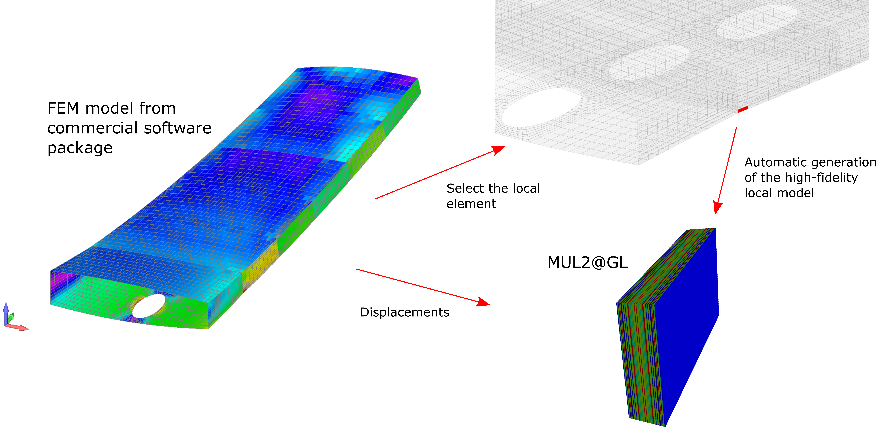
Figure 1: View of a composite wing box and failure index contour. On the right side a zoom showing the critical element highlighted in red, and the local model generated by the MUL2@GL tool.
Our method to avoid this issue is to define the single laminate elements as independent local areas. In this manner, the local model can be created automatically from the element information located in the analysis input file, and no further actions are required from the user. Furthermore, the EW approach is consistent with the outputs delivered by 2D linear elements. The left-hand image of Fig. 1 shows an example of typical failure evaluation performed on a composite wingbox using a typical commercial FEM package and the Hoffman stress criteria. The FEM analysis provides an element-wise distribution of the ply stresses and strains over the surface of the plate element. In this context, the EW plug-in is introduced as a mean to extract the 3D solutions at the centroid of the element for generic cases, thus offering a more realistic prediction of the mechanical unknowns across the stack of plies.
3. Numerical example
To demonstrate the capabilities of the proposed method we evaluate the stress fields in a benchmark composite wingbox. The FEM model is shown in Fig. 1 (left) and it is made of 1D and 2D elements, including beams for stringers and reinforcements, and plate and laminate elements for ribs, spars and skins. Different lay-ups of unidirectional tape are used over the skin and spar surfaces, ranging from 28 at the spar webs to 62 plies at top and bottom skins nearby the wing root. The material properties selected are those of a IM7-8552 carbon fiber tape.
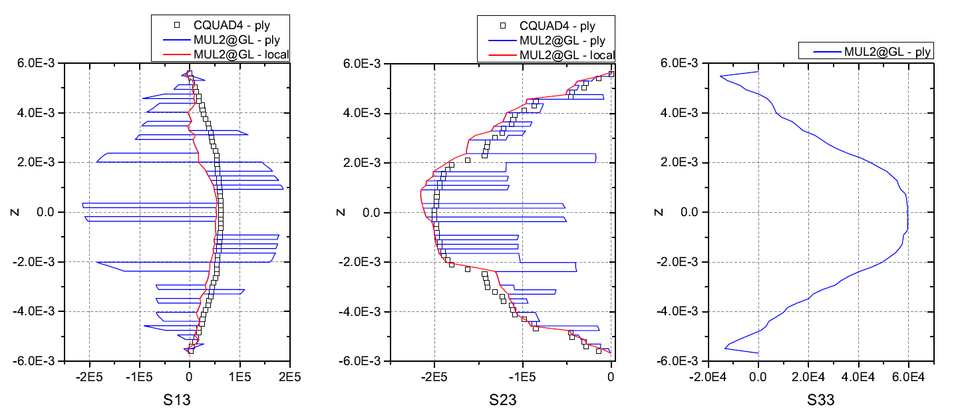
An arbitrary element of the top skin near the clamped edge is picked for the global/local analysis. By selecting the element, the MUL2@GL automatically passes the information from the FEM model to the high-fidelity local analysis and generates the 3D solutions for strains, stresses and required failure indexes. Figure 3 shows the transverse shear values of the stress tensor at the centroid of the local element (blue lines). One can notice that the differences between the laminate plate outputs and the local model are substantial.
Figure 2: Out-of-plane shear stresses at the selected element of the top skin.
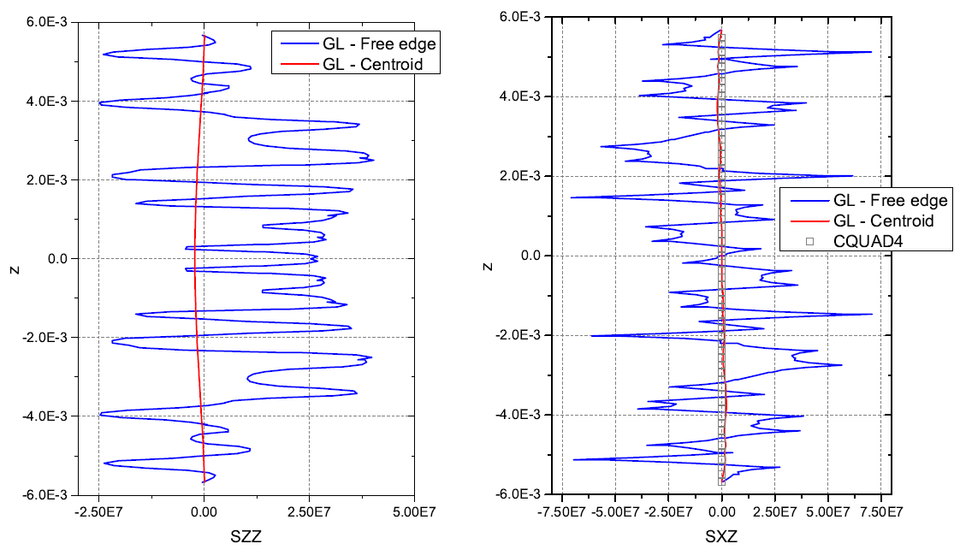
The assumptions adopted by laminate plates fairly hold for thin structures and simple laminations. In addition, the plate elements cannot predict the complex states of stress that develop around holes, cut-outs and over the edges of the laminated structure. As an example, Fig. 4 shows the distribution of SZZ and SXZ across the stack of plies at the free edge in the element coordinate system (X is parallel to the wingspan). It also shows the same values computed at the centroid of the element by the local model (red line) and the global one (square dots). One can observe how the interlaminar stresses increase by one or two orders of magnitude from the centroid to the free edge.
Figure 3: Normal and transverse shear stress distributions across the thickness at the free-edge.
4. Conclusions
This paper has discussed a user-friendly tool for the obtention of 3D stress solutions in generic composite analysis using a commercial FEM package and a freely-available plug-in developed at Politecnico di Torino. The code allows structural engineers to complement their stress analyses with more accurate and reliable solutions. The availabilityof all the components of the stress tensor allows for the consistent use of advanced composite failure criteria which can predict various failure modes of the laminate structure.
5. References
Carrera, E., Cinefra, M., Petrolo, M., Zappino, E. (2014). Finite Element Analysis of Structures Through Unified Formulation: John Wiley and Sons.
de Miguel, A.G., Kaleel, I., Nagaraj, M.H., Pagani, A., Petrolo, M., Carrera, E. (2018). Accurate evaluation of failure indices of composite layered structures via various FE models: Composites Science and Technology, vol. 167, pp. 174-189.
This site uses cookies that enable us to make improvements, provide relevant content, and for analytics purposes. For more details, see our Cookie Policy.
By clicking Accept, you consent to our use of cookies.