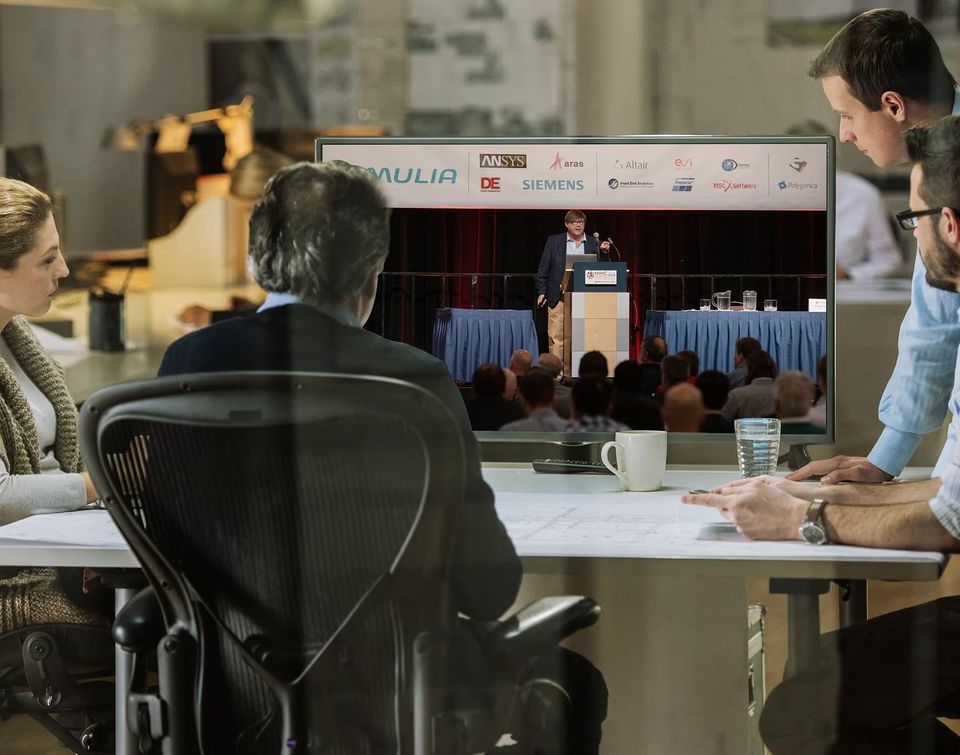
NAFEMS, the premier global organization dedicated to the advancement and improvement of engineering simulation, hosted the 2012 North America Conference just outside of Washington D.C. on September 11-12, bringing together the leading visionaries, developers, and practitioners of CAE-related technologies and business processes to share relevant trends and roadmaps, to explore common themes, and to address these issues in an open forum. The Conference’s goal was to provide attendees with insightful content and perspective on how to position their organizations to realize the full potential of CAE.
Presentations
KEYNOTE ADDRESS
Pathway to Future Virtual Product Creation in the Coming Intelligence / Convergence Era
Ahmed K. Noor, Old Dominion University
Dr. Noor's presentation will identify some of the characteristics of the coming intelligence/ convergence era, future complex adaptive systems, and their implications on virtual product creation.The need is described for establishing an Intelligent Cyber-Physical Ecosystem for facilitating interdisciplinary collaborations among engineers, researchers, scientists, software developers and other stakeholders working on the development and applications of the new interdisciplinary fields and the future complex adaptive systems. The new interdisciplinary fields will yield critical advances in engineering practice, and help in addressing future challenges in broad array of sectors, from manufacturing to energy, transportation, climate, & healthcare. They will stimulate creativity and innovation; invigorate engineering education, accelerate the development of skilled workforce needed in the new era. The major components of the ecosystem will be identified in Dr. Noor's presentation.
Manufacturing Tomorrow...Today
Jon Riley, VP of Digital Manufacturing at NCMS
Jon Riley’s presentation will consider the future of manufacturing and how engineering simulation will enhance and facilitate innovation in North America. As Vice-President of Digital Manufacturing at NCMS, Jon Riley will provide a unique insight into manufacturing across a wide range of industries.
PLENARY PRESENTATIONS
popielas.pdf
CAE and its Role 2020 and Beyond for the Engineering Community
Frank Popielas, Dana Holding Corporation
The current state of the global economy is being discussed in quite a few papers,especially the role of CAE for the engineering community. The selling price is not the main and only driver to a product’s competitiveness any more. Being competitive means much more then that nowadays, it includes engineering support structure towards the customer, engineering support technology, time-to-market, quality guarantee at any point in time, product information access any time and, of-course,development and product costs. This presentation will discuss CAE, or better, an optimized virtual infrastructure as the only solution to achieve this.
seitzman.pdf
Physics-Based Simulation: Helping Shape Future Cat Products
Larry Seitzman, Caterpillar
A company's product development process is responsible for delivering to the market the product the customer wants while satisfying the expectations of the company's shareholders. As the market moves faster and the products become more complex,the use of physics-based simulation is critical to achieving this combination of success factors. In this presentation, Larry Seitzman will discuss Caterpillar's journey towards Virtual Product Development and some of the challenges Caterpillar face getting simulation accepted into the product development community and the nextsteps in organization's journey.
doerry.pdf
Set Based Design Methods with Respect to Design Synthesis and Analysis Tools
Norbert Doerry, Naval Sea Systems Command
SBD can be thought of as design by elimination. One systematically decides the regions of the possible design space that are NOT the answer, then analyzes in more detail the remaining design space to see what additional area of the design space can be eliminated. Ideally, the remaining possible design space will shrink as the amount of detail required to support the next design space contraction decision increases (resulting in roughly the same amount of design work per "iteration") Eventually you end up with a feasible design space from which you can pick an arbitrary solution. This contrasts with the more traditional approach of trying to initially pick a winner and marginally modify if when more detailed analysis reveals problems. Norbert Doerry's presentation will explore how design decisions are made to Set Based
Design(in contrast to a more traditional Point Based Design) and how SBD challenges Design and Analysis Tool developments.
Making Simulation Business Relevant
Chad Jackson, Lifecycle Insights
There's little doubt that simulation and analysis is a highly technical engineering field.It is not, however, devoid of business relevance. In fact, these tools and technologies can have a profound impact on the effectiveness of the engineering organization.Based on his recently published eBook, The Engineering Manager's Survival Guide,Chad Jackson will talk about how initiatives such as Just-in-Time engineering and Agile Product Development are directly supported by specific simulation and analysis technologies like SPDM, topology optimization and more.
morrison.pdf
Regulatory Perspectives on Computational Modelling
Tina Morrison, Food and Drug Administration
Computational modeling has been recognized by the Center for Devices and Radiological Health as an innovative tool for advancing medical device evaluation and regulatory science. One of the strategic priorities for 2012 is the development of a Public-Private-Partnership centered around advancing regulatory science with computational modeling. Many efforts are underway to help further this initiative,including projects to collect data on boundary and loading conditions. Thus, the goal of Tina Morrison;s presentation is to highlight the current uses of computational modeling in device applications, present some of the challenges and limitations, and discuss what we can do as a community to advance regulatory science with computational modeling.
Computation, Measurement, and Standards
Andrew Dienstfrey, NIST
Scientific computing is increasingly used to inform decision-making in science and engineering, commerce, and policy. However, there are indications that in some cases critical qualities of these computations—for example, their reproducibility, and quantitative statements of accuracy and confidence in their outputs—are insufficiently characterized and understood. In this presentation, Andrew Dienstfrey will discuss research within NIST to address these challenges by presenting scientific computation as a new form of measurement. As such, it is anticipated that, in consultation with a broad cross-section of stakeholders, a uniform practice of uncertainty analysis and accuracy standards for scientific computing may be defined and promoted. Preliminary applications of these ideas in the areas of computational benchmark problems and medical device simulation will also be presented.
TRACK 1 - Day 1
SIMULATION AND PROCESS DATA MANAGEMENT I
norris.pdf
Business Value for Simulation Data Management - Key Lessons from Early Adopter
Mark Norris, Infosys
britto_maria.pdf
Simulation Data Management Challenges in the Aerospace Industry
Rodrigo Britto Maria
Simulation Life Cycle Management and it’s Game Changing Role in the Current CAE World
Rohit Ramkumar, Dana Holding Corporation
SIMULATION AND PROCESS DATA MANAGEMENT II
tabaste.pdf
Being Prepared for the Future: Trade-Off Management Technology for Architects within Designing the Robust Virtual Aircraft
Olivier Tabaste, MSC Software
walin.pdf
Achieving Integrated FEA Model and Loads Management
Tom Walin, MSC Software
dufour.pdf
Aerospace Finite Element Postprocessing Needs
Paul Dufour, The Boeing Company
TRACK 2 - Day 1
DESIGN UNCERTAINTY QUANTIFICATIONS
allen.pdf
Simulation-Supported Learning
Gene Allen, Decision Incite
raphael.pdf
Reducing Uncertainty in Fatigue Life Estimates
Julian Raphael, J R Technical Services
alberts.pdf
CAE Based Robust Design Optimization in a Virtual Product Development
Matthias Alberts, CADFEM
METHODS
genc.pdf
New Developments in Image-based Mesh Generation of 3D Imaging Data
Kerim Genc, Simpleware
nannucci.pdf
Designing Structures to Withstand High Speed Fluid Impacts
Peter Nannucci, SIMULIA, Dassault Systèmes
manning_led.pdf
Characterization and Numerical Simulation of LEDs
Andy Manning, Mentor Graphics
OPTIMIZATION
Driving Multidisciplinary Optimization Using State-of-The-Art Simulation Technologies — End User Case Studies
Ravi Nimbalkar, BETA CAE Systems USA
miller.pdf
Modern Topology and Shape Optimization Methods for Product Development
Mark Miller, FE-DESIGN Optimization
Various Uses of Multi-Objective, Multi-Disciplinary and Robust Design Optimization
Nader Fateh, Esteco North America
de_lima.pdf
Applying Optimization to Drive Design of a 100m Composite Wind Turbine
Carlos de Lima, Altair
TRACK 3 - Day 1
COMPOSITES
Future Approaches to Composite Material Modeling for Industrial Applications
Jan Seyfarth & Roger Assaker, e-Xstream engineering
Applying the Submodeling Technique to Ballistic Impact of Textile Composite Structures
Wieslaw Binienda, The University of Akron
colsoul.pdf
Topology Optimization of Composite Structures with Continuous Design Variables with Design Rules and Blended Laminates
Frank Colsoul, LMS
HIGH PERFORMANCE & CLOUD COMPUTING I
Breaking Down the Barriers to Simulation - Harnessing the Cloud to Democratize Simulation
Grant Rochelle, Autodesk
pierce.pdf
HPC as CAE Enabler
Dan'l Pierce, MSC Software
murgie_cloud.pdf
How Does The Cloud Change the Simulation Landscape?
Rita J Schnipke, Autodesk
HIGH PERFORMANCE & CLOUD COMPUTING II
Accelerating AMLS Based Substructure Generation Procedure Through High-Performance Computing
Vladimir Belsky, SIMULIA, Dassault Systèmes
posey.pdf
Case Studies of GPU Computing for Applied CAE
Stan Posey, NVIDIA
terrier.pdf
How to Reduce the Simulation Time (CPU time) Without Any Precision Decrease
Francis Arnaudeau, Altair
Collaborative Open CAE Platform for CFD
Kenji Shimada, Ceispace Corporation
TRACK 1- Day 2
CAE TRENDS
Advanced Engineering Simulation: Allowing Technip to Take it Further
Brian Duffy, Genesis
ladzinski.pdf
Developing a Close Collaborative Relationship Between Engineering Analysis and Systems Engineering
Edward Ladzinski, NAFEMS North American Steering Committee
OPTIMIZATION
rots.pdf
3D FEA Variation Analysis Modeling
Rick Rots, Dimensional Control Systems
jenkins.pdf
Design Space Exploration
Bruce Jenkins, Ora Research
DYNAMICS
komzsik.pdf
Finite Element Analysis of Rotating Structures
Dr. Louis Komzsik, Siemens PLM
pray.pdf
Efficient Interactive Graphic Simulation of Shock and Vibration Tests
Carl Pray and Dan Hensley, ATA Engineering
barrie.pdf
Absorbing Boundary Condition for Seismic Simulations in Panama Canal 3rd Set of Locks Design
Richard Barrie, MWH Global
murgie_eigenvalue.pdf
Linear Dynamic Simulation with a Faster Modal Solver
Sam Murgie & James Herzing, Autodesk
TRACK 2 - Day 2
MEDICAL DEVICES I
Computational Fluid Dynamics and Blood Damage Validation Studies Sponsored by the Food & Drug Administration's Critical Path Initiative
Sandy FC Stewart, FDA
qiao.pdf
Uncertainty Quantification in the Verification of Stent Computational Models
Xiao-Yan Gong, Medical Implant Mechanics, LLC
lawrenchuk.pdf
Engineering on Anatomy: Designing Patient Specific Medical Devices and Implants
Mike Lawerenchuk, Materialise
STRATEGIC USE OF SIMULATION
nagy.pdf
Example of the Importance of Standardization of Recurring Tasks: Maintenance and Repair of Aircraft - Components at NAVAIR
Dennis A. Nagy, Software Research and Development, Inc. (ESRD)
Engineering Analysis & Simulation in Aerospace Industry: The Challenges and Opportunities
John Jian Dong, The Boeing Company
MEDICAL DEVICES II
Example Method for Validation of FEA to Inform Medical Device Design and Bench Test Optimization
James Coburn & Finn Donaldson, FDA
A Computational Platform for Design-Phase Evaluation of Knee Replacement
Paul J. Rullkoetter, OrthoAnalysts
elabbasi.pdf
Finite Element Modelling of Bone Screw Pullout
Nagi Elabassi, Veryst
TRACK 3 - Day 2
MULTIPHYSICS I
cheng.pdf
Simulation and Validation of Active Control of Limit Cycle Oscillation in Aeroelastic Systems (Cyber–Physical Systems)
Ron-Bin Cheng, SIMULIA, Dassault Systèmes
Co-Simulation in Automotive Applications
Klaus Wolf, Fraunhofer SCAI
eggenspieler.pdf
Predicting the Performance of an Electric Motor via a MultiphysicsSimulation: Coupling Electromagnetic, Fluid, and Structural Simulations
Gilles Eggensplier, ANSYS
MULTIPHYSICS II
Advances in Multiphysics Simulation
Ted Wertheimer, MSC Software
prasad.pdf
Coupled Electromagnetic and Fluid-Structure Interaction Analysis of a Solenoid Valve
Sharat Prasad, SIMULIA, Dassault Systèmes
VALIDATION
Techniques to Avoid Experimental Errors in Complex Systems for Better Model Validation and Improved Optimization Processes
Sean Hollands, Polytec
manning_cavitation.pdf
Cavitation Process Simulation For Industrial Applications
Andy Manning, Mentor Graphics
lastiwka.pdf
Design and Optimization of a Thermoelectric Generator Cooling System using Computational Fluid Dynamics
Derek Lastiwka, Vivid Numerics
dreisbach.pdf
Wrap-Up & Closure
Rod Dreisbach: Chairman of the NASC